Every day in Maine, people miss medical appointments, fall behind in school, lose job opportunities, and lose touch with family — not because of a lack of willingness, but because of a lack of a working device. A stolen iPad. An old laptop that can’t run modern software. A smartphone that just isn’t enough.
In this webinar, Jessica Perez of the Maine Connectivity Authority and Alan Cornwall of Give It, Get It break down how Maine businesses can make a real, immediate difference — by donating the tech they no longer need. From data security to environmental compliance to the stories of real people whose lives changed because of a refurbished computer, this conversation covers everything you need to know about the Maine Tech Share campaign.
Watch the full webinar below, or read the transcript to learn how your organization can get involved.
Webinar Transcript Closing the Digital Divide in Maine Through Device Donation Hosted by: Maine Connectivity Authority & Give It, Get It
OPENING & INTRODUCTIONS
Jessica Perez | Senior Manager, Digital Opportunity — Maine Connectivity Authority Welcome, everyone. I’m Jessica Perez, Senior Manager for Digital Opportunity at Maine Connectivity Authority, joined by Alan Cornwall from Give It, Get It.
Alan Cornwall | Give It, Get It — Business Reuse & Recycling Advocate Hello all.
ABOUT MAINE CONNECTIVITY AUTHORITY
Jessica Perez We’ll give a 30-minute overview of how you can support closing the digital divide in Maine through device donation, with time for Q&A at the end. Feel free to introduce yourself in the chat and drop questions along the way.
MCA focuses on three goals: ensuring every home and business in Maine has access to high-speed internet; making sure people have the skills and resources to use it; and building infrastructure that lasts not just for today, but for the long term.
We’ve made significant progress. In June 2022, very few areas had broadband-level service. By 2024, that had grown considerably — and it’s continued to grow since.
We’re also building out the internet backbone. Right now, Maine’s backbone runs roughly along I-95, which leaves the eastern and western parts of the state underserved and creates no redundancy. We’re addressing that through a $53 million federal grant to build an east-west backbone with long-term public benefit.
We’re also working on cellular and wireless connectivity — there are significant gaps across the state. We’ve completed a study, and a draft plan will be made public this spring.
DIGITAL OPPORTUNITY WORK
Jessica Perez Infrastructure alone isn’t enough. If people don’t have the skills or resources to use a connection, it won’t accomplish what we need it to.
Digital opportunity means people can afford connectivity, have the skills to use a device, can access tech support, and know how to stay safe online. In our early research, we found that many people didn’t know where to turn for help — their only answer was a tech-savvy grandkid.
This work focuses on populations facing barriers: older adults, veterans, people with disabilities, low-income households, and rural residents — which, frankly, covers most of Maine.
Two examples of what we’re doing: Tech Help for ME (techhelpforme.org) is a public directory where anyone can find nearby Wi-Fi, public computers, video call rooms, and tech classes — written in plain language, available in multiple languages, accessible on any device.
The Connectivity Hubs program funded nine community anchor institutions across Maine to make capital improvements and offer digital opportunity services — tech classes, loaner devices, video call rooms, and programs tailored to their communities, from coastal fishermen to older adults. These hubs are mostly in construction now and will all be fully operational next year.
ROBERT’S STORY & THE MAINE TECH SHARE CAMPAIGN
Jessica Perez There’s still a real problem, and I want to illustrate it with Robert’s story. Robert is an older veteran in Bangor whose iPad was stolen. Money is tight — his wife is sick and their resources go toward her care. He reached out to us because he used that iPad to order prescriptions, access veteran services, and stay connected to his community.
In another state, the answer might have been no. In Maine, we were able to connect him with Give It, Get It, who got him a refurbished computer. Robert only paid for shipping.
There are a lot of Roberts out there. That’s why we launched Maine Tech Share — a campaign asking Maine businesses to donate their unused devices to be refurbished and distributed to people who need them. Our goal is 25,000 devices.
GIVE IT, GET IT: DATA SECURITY, ENVIRONMENT & SOCIAL IMPACT
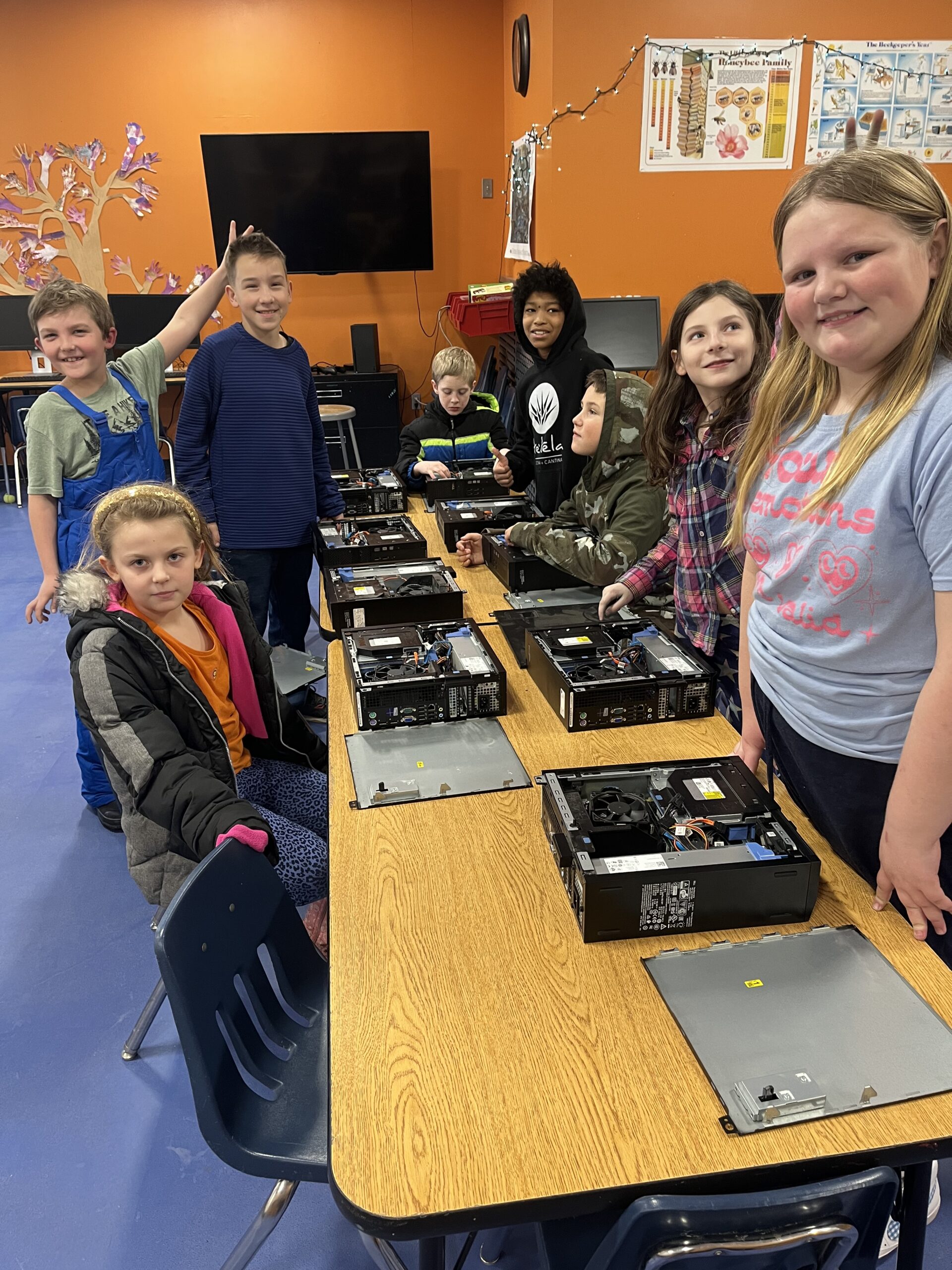
Alan Cornwall We’re excited about this partnership. What businesses call “end-of-life” technology often still has plenty of life left — we even receive new equipment sometimes.
Data Security
Data security comes first. Whether or not you think your devices hold sensitive information, they do — employee data, client data, intellectual property. We control the chain of custody from your facility to our truck. Devices go into a dedicated retired tech locker, are processed first-in, first-out, and handled according to your compliance standards — GLBA, HIPAA, FERPA, PCI, criminal justice, and others.
We go beyond hard drives. We look for SIM cards in laptops, SD cards tucked under keyboards (Lenovo is known for this), and thumb drives — anything that could carry data.
Environmental Impact
Even intact devices contain heavy metals that leach into groundwater. Burning them releases fire retardants and other pollutants. And only about 9–10% of plastic is actually recycled due to the complexity of sorting different types. Our mission is to reuse everything we can and properly recycle the rest.
Give It, Get It has been doing this since 2002 — we were the first DEP-licensed e-waste facility in Maine, operating before that licensing process even existed.
Environmental Compliance
Maine is one of the strictest states in the country on e-waste regulation. Most businesses don’t know this, but Maine DEP requires any business with more than five employees to report their e-waste to the state. We handle that reporting on your behalf.
We’re also registered under Maine’s Product Stewardship Program — the only organization in Maine with this registration — which allows us to charge back manufacturers for commonly recycled items like monitors and desktop printers. That means we can actually reimburse clients for those items rather than charging them.
SOCIAL IMPACT: WHO WE HELP
Alan Cornwall Digital inclusion requires four things working together: affordable internet (what MCA is building), digital literacy training, technical support, and a reliable device. A smartphone alone isn’t enough for most of what people need to do.
We work with nonprofits across Maine to get devices to the people they serve — someone like Brad, who just needs a computer to build the skills for his next job. We serve single parents going back to school, elders using telehealth, children from low-income families, and people re-entering society after incarceration.
On that last group: a teacher friend of mine used to teach both at a community college and at a correctional facility. I assumed his better students were at the college. He said it wasn’t close. The people inside know it’s a chance at a different life — and the recidivism rate for those who engage in education is negligible. A device can be part of that path forward.
Q&A
Alex | Mapping Specialist, Direct Communications Is there a specific list of devices you’re looking for? We have IT equipment including some telco-specific items.
Alan Cornwall We take pretty much everything in your IT environment. Think of it like gold mining — we sift through everything to find what can be reused or repurposed. Items we can’t use directly, we may sell to fund the program. The goal is to make it simple for you, and donating everything also takes care of your DEP reporting in one step.
Jessica Perez Martha Morrison asks whether there’s a way to update Windows 10 devices to Windows 11.
Alan Cornwall Many devices simply won’t support Windows 11 — that’s actually why a lot of them come to us. As a Microsoft Authorized Refurbishment Partner, we install Linux Mint on those machines to keep them functional and compliant. There are workarounds for unsupported hardware, but they’re not Microsoft-sanctioned — reach out to me directly if you want to talk through your specific situation.
Jessica Perez To get started, visit the Maine Tech Share link and submit your contact information. We’ll follow up with next steps.
Alan Cornwall It’s a simple process — I’m happy to answer any questions along the way.
CLOSING
Jessica Perez Thank you all for joining us. Visit the Maine Tech Share link to get involved, and we’ll take good care of you.
Alan Cornwall Thanks everyone — hope to hear from you soon!
Maine has built something worth being proud of: donated devices are securely wiped, responsibly refurbished, and put into the hands of veterans, seniors, students, and families working hard to get ahead.
The goal is 25,000 devices. That old laptop sitting in your storage closet could be someone’s connection to healthcare, education, or their next job.
Donate your devices with give IT. get IT.
Pickup, data destruction, and DEP compliance reporting.
Your old tech. Someone’s new opportunity.