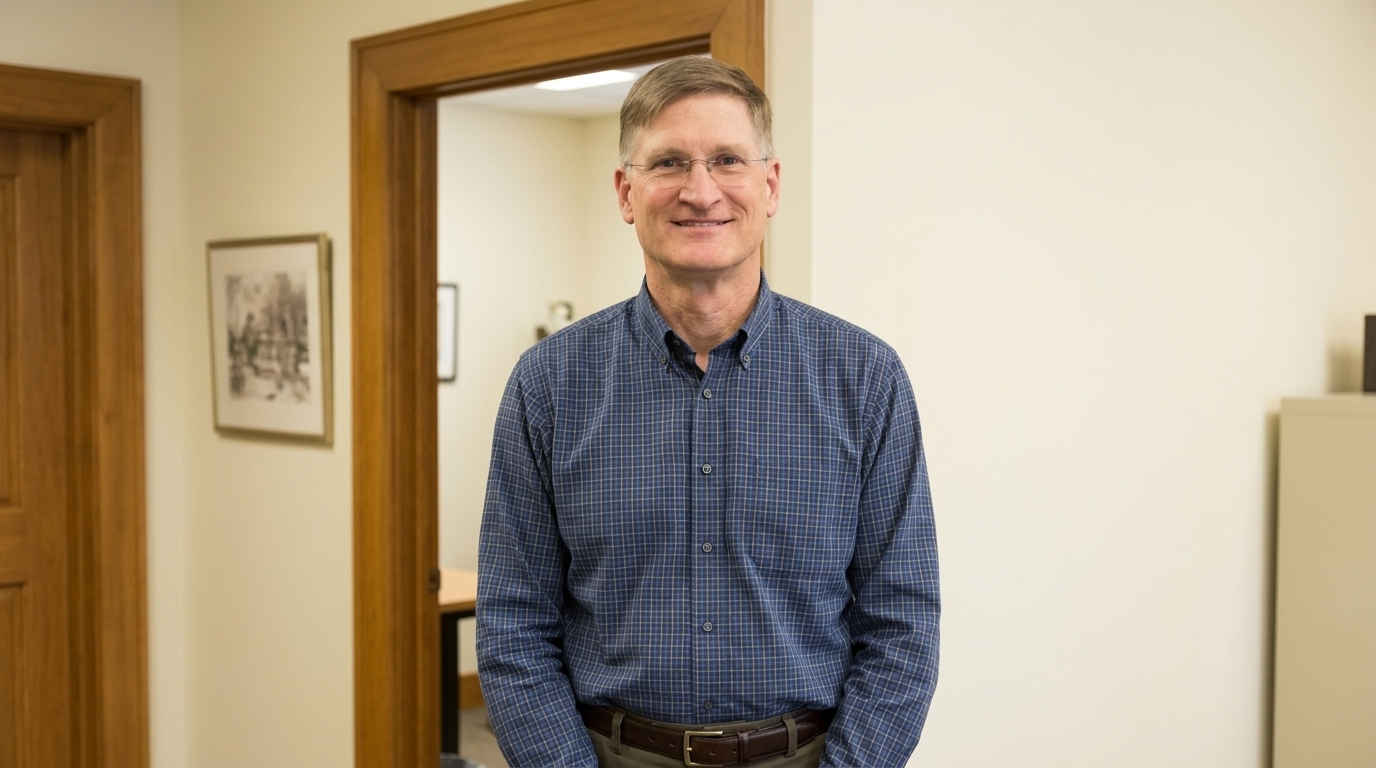
For six years, Marty Duggan was responsible for retiring outdated electronics at Sappi, the global paper and pulp company where he spent 28 years, most of them in corporate IT. That responsibility, unglamorous as it sounded, would end up connecting him to two people who were just beginning to build something remarkable in Belfast, Maine: Chris and Jodi Martin, the founders of what would become give IT. get IT.
It started, fittingly, with a basement full of junk.
A Basement in Boston
Sappi’s corporate offices were preparing to relocate to a new space near the Boston waterfront, and buried in the building they were leaving behind was a storage room holding thirty years of accumulated e-waste. Marty had already tried a couple of out-of-state vendors to dispose of Sappi’s old equipment, paying five or six thousand dollars a year for the privilege and receiving next to nothing in return. He wanted something better: a partner who was local, accountable, and genuinely invested in where the equipment ended up.
Through the State of Maine, he found what was then called ITE, the only registered nonprofit and sustainability-focused organization of its kind in the state. He reached out to Chris, who sent over documentation for a transfer-of-ownership agreement. Sappi’s legal department balked at the original draft, so Marty, who had spent years operating as an in-house consultant to executives across the company, went straight to the company’s lead counsel in Boston and asked for help. A local Sappi attorney reworked the agreement until it met the company’s needs, and the two sides went back and forth until it was approved.
That document, remarkably, is still in use today.
Not long after, Marty and a crew loaded roughly nine pallets, an estimated 20,000 pounds of old servers, switchers, and other equipment, onto a truck bound for Belfast. It was the beginning of a relationship that would shape both organizations for years to come.
Chris still remembers making that first pickup himself.
“Marty’s intersection with the organization came at a critical time, where we were transitioning from a grassroots technology access experiment toward a stable and sustainable, quality-oriented organization,” he says. “I first met him at Sappi’s office in downtown Boston, where he was working at the time, to pick up a load of technology donations.”
Bringing Sustainability to South Portland
Marty did not stop at logistics. He invited Chris up to Sappi’s offices in Maine to speak directly with employees in South Portland about the organization’s mission: keeping usable technology out of landfills while giving people who needed access to computers a way to get one. The talk resonated. People who worked at Sappi began to understand the deeper purpose behind the partnership and started spreading the word themselves.
Eventually, Marty asked Sappi’s CEO for permission to join ITE’s board, a request he needed sign-off on since the organization was also a Sappi vendor.
Permission granted, he became one of the earliest outside voices helping steer the young nonprofit – work that Sappi itself endorsed as a way of supporting a mission-driven partner in the community.
A Career Built on Learning How to Lead
None of this would have happened, Marty says, without a week at the Center for Creative Leadership in Greensboro, North Carolina, that changed the direction of his career.
Earlier in his time at Sappi, he was sent to this intensive, week-long management training alongside a room of CEOs, department heads, and supervisors like himself.
“I guess Sappi saw potential in me, to send me to such a prestigious training center,” he jokes now. Before it began, the twelve people who reported to him and his peers were asked to complete a confidential evaluation of his leadership. Out of thirty participants in the class, Marty scored the lowest.
It was humbling, and it worked. The training, built around psychologists, leadership experts, and days that stretched from breakfast to well past dinner, forced him to confront how much he had been micromanaging people who often knew their jobs better than he did. He came home and apologized to his team. Then he changed how he led.
“My job is to keep roadblocks from them so they can do their job,” he says of the philosophy he built from there. Other managers at Sappi began asking him why his team liked him so much. His answer was simple: he paid attention to them, and he stopped acting like he knew more than the people doing the work.
That shift did more than change his own team. It transformed one of the lowest-regarded departments at the company. When Marty took over desktop support and the helpdesk, employees had a nickname for it: the “no helpdesk.” Teams did not share knowledge, turnover was constant, and the department was treated as expendable rather than as an entry point into a real IT career.
Marty rebuilt it from the ground up. He required every team member, including himself, to pursue professional certification through HDI, a worldwide help desk and support organization. He instituted weekly stand-up calls that connected staff across Maine, from Skowhegan to Westbrook, so people could share what they had learned that week and learn from each other’s mistakes rather than fear them. He asked employees to set their own goals instead of dictating targets to them, something no manager there had done before.
Within six years, the department that once could not shake its unflattering nickname ranked 46th out of 850 organizations worldwide in customer satisfaction, according to HDI’s own benchmarking.
Retirement, and a Second Calling
When Marty retired from Sappi, he expected to spend his days doing very little, possibly working retail to stay busy. Instead, Chris called him while he was still on vacation and asked if he would come on as a consultant to help Jodi build out the organization’s management structure in Belfast.
For the next two years, Marty worked in Belfast three days a week. He made the 2.5 hour drive to Belfast and stayed in a hotel across the street two nights a week. His wife even packed his lunches and dinners to keep expenses down.
He worked closely with Jodi to help her step back from doing every task herself and grow into the role of a manager who could delegate, plan, and lead a team from a distance rather than from the floor. Together they tackled performance reviews, goal setting, employee recognition, budgeting, safety, documentation, and standards, among other things. He brought the same principles that had turned around Sappi’s helpdesk: certification, shared learning, and a constant-improvement mindset borrowed from a simple framework called “2 Second Lean,” which every member of give IT. get IT.’s staff still uses today.
After two years, Marty told Jodi that he would step back from paid consulting. What began in Chris and Jodi’s kitchen with a handful of old computers from Chris’s earlier business has since grown into an organization with an annual budget in the seven figures.
“I feel like I did such a small thing for them,” Marty says. “They look at it as a large thing, but to me it was minor. I just helped move it along and gave them some ideas.”
Jodi sees it differently.
“Marty was more than a consultant. He is still my mentor and a friend to my entire family,” she says. “He taught me that the little things, the simple things, can make a big impact.” One piece of advice has stayed with her for years: to sleep on a drafted email, since its tone often changes after a good night’s sleep. “That advice has saved me so much trouble, even to this day.”
The 2 Second Lean framework Marty introduced is now used by every member of give IT. get IT.’s staff, Jodi says, and it has saved the organization thousands of dollars and countless hours. Marty also mentored her through the purchase of a partner organization, a decision she calls the catalyst for the success give IT. get IT. has today.
“It is not something I can easily point to and say, this was the defining moment, because it was so many little things over the years that changed me as both a manager and an individual,” Jodi says. “I am forever grateful for Marty’s advice, and I still ask for his assistance now and again. I cannot thank him enough for all that he has given me.”
Chris agrees that Marty’s impact is hard to sum up in a single story.
“His impact on the organization is too broad to list, but across most of the organization’s processes, messaging, leadership, and team building needs, Marty has been a consistent north star for many members of our team, past and present,” he says.
“For me personally, he has always been there to support us and our mission, whether as a volunteer, consultant, or board member, and he constantly kept the focus on empowering people, both inside the organization and those we support,” Chris adds. “Technology access, while incredibly important, is just a pathway. Empowering people is always the purpose.”
Marty still keeps an eye on the give IT. get IT. board from a distance these days, glad, he says, to see a strong new group of leaders ready to take the organization to its next stage.
give IT. get IT. is a Maine-based 501(c)3 nonprofit working to close the digital divide across New England.
Want to support work like Marty’s? Learn how to give IT or reach out to our team.
Read more about give IT. get IT.